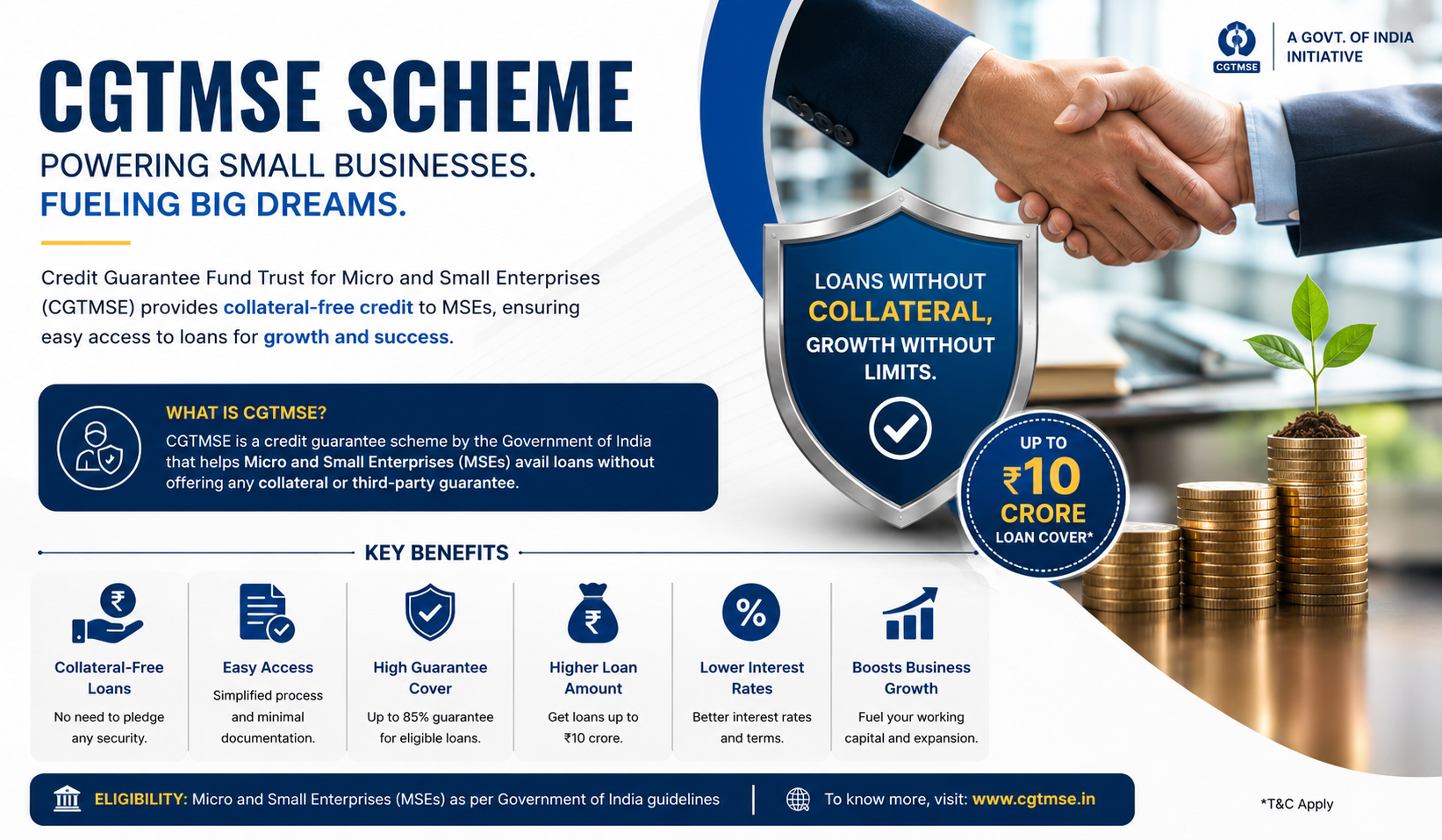
A CGTMSE loan is a business loan given to a Micro or Small Enterprise by a bank or NBFC without asking for collateral or a third-party guarantee, because the Credit Guarantee Fund Trust for Micro and Small Enterprises (CGTMSE) backs a large portion of the lender’s risk. Set up in August 2000 by the Ministry of Micro, Small and Medium Enterprises and SIDBI, the scheme currently guarantees eligible loans up to ₹10 crore (₹20 crore for DPIIT-recognised startups under the linked CGSS window), with the Trust covering 75% to 85% of the amount in default. If you run a small manufacturing unit, a services business, or a trading firm and have been told you need to mortgage property to get funded, CGTMSE is very likely the reason your bank can say yes without asking for that. This guide walks through how the scheme actually works, current loan limits and guarantee cover, eligibility, the fee you’ll pay, the documents you’ll need, and the step-by-step process — along with where a Chartered Accountant’s involvement typically saves borrowers time and rejected applications.
What Is CGTMSE and How Does It Work?
CGTMSE stands for Credit Guarantee Fund Trust for Micro and Small Enterprises. It is not a lender — it never hands money to a business directly. Instead, it sits behind the lender as a guarantor. When an eligible bank or NBFC (called a Member Lending Institution, or MLI) sanctions a loan to a Micro or Small Enterprise without collateral, the MLI applies to CGTMSE for guarantee cover on that loan. If the borrower later defaults, CGTMSE compensates the lender for a defined percentage of the loss — not the borrower, and not the borrower’s obligation to repay.
This distinction matters: a CGTMSE-backed loan does not reduce what you owe or offer any relief if you fall behind on payments. What it does is remove the single biggest reason small businesses get turned down for credit — the lack of property, gold, or other security to pledge. Because the lender’s downside is partly covered, banks and NBFCs are far more willing to fund first-generation entrepreneurs and asset-light businesses that a conventional secured-lending process would reject outright.
CGTMSE Loan Limit and Guarantee Coverage (Current)
The numbers that matter most to a borrower are the loan ceiling and how much of it the Trust actually guarantees. As of the current scheme year:
- Maximum loan amount: Up to ₹10 crore per eligible borrower across all Member Lending Institutions combined. DPIIT-recognised startups can access up to ₹20 crore under the linked Credit Guarantee Scheme for Startups (CGSS).
- Guarantee cover: Typically 75% to 85% of the amount in default, depending on the loan size, sector, and borrower category.
- Higher cover for priority categories: Women entrepreneurs, SC/ST-owned enterprises, businesses in the North Eastern Region, and ZED (Zero Defect Zero Effect)-certified units generally receive coverage at the higher end of the band, which materially improves approval odds since the lender’s residual risk drops further.
- Credit facilities covered: Both term loans (for machinery, expansion, capital expenditure) and working capital facilities such as cash credit and overdraft are eligible, provided they’re extended without collateral or a third-party guarantee.
One point causes real confusion: the guarantee cover is what the lender can claim from the Trust if you default — it is not a subsidy or a discount on your loan amount. Your full loan is disbursed and your full repayment obligation stands regardless of the guarantee percentage behind it.
Who Is Eligible for a CGTMSE Loan?
Eligibility under CGTMSE is built around the borrower’s classification and activity, not around personal wealth or collateral availability:
- Entity type: New and existing Micro and Small Enterprises engaged in manufacturing or service activity, including proprietorships, partnerships, LLPs, private limited companies, Self-Help Groups, and Joint Liability Groups.
- Udyam Registration: A valid Udyam Registration Certificate classifying the business as Micro or Small is a basic requirement most lenders will ask for before processing a CGTMSE-backed application.
- PAN: An Income Tax PAN is required for the borrowing entity, except for loans up to ₹5 lakh, where CGTMSE does not presently insist on it at the time of guarantee cover.
- Sector: Manufacturing and the full range of MSMED Act-defined service activities are eligible, including retail trade and small road/water transport operators.
- What’s excluded: Agricultural or farm-sector activity, loans already covered under NSIC’s own guarantee schemes, and credit facilities carrying another government-backed guarantee generally fall outside CGTMSE’s scope. Medium enterprises (as opposed to Micro and Small) are not covered under the core scheme.
What Does a CGTMSE Loan Actually Cost? (Annual Guarantee Fee)
The Annual Guarantee Fee (AGF) is the fee a lender pays to CGTMSE to keep the guarantee cover active each year, and it starts from 0.37% per annum, scaling up depending on the loan amount, tenure, and the lender’s risk rating of the borrower. Technically, the AGF is charged to the lender — but in practice, many banks and NBFCs pass this cost through to the borrower, either as a separate charge or built into the effective interest rate. It’s worth confirming this explicitly with your lender before signing terms, since it changes the real cost of the loan.
Documents Typically Required
While exact checklists vary by lender, most CGTMSE loan applications require:
- Valid Udyam Registration Certificate
- PAN card of the business and promoters
- KYC documents for all promoters/partners/directors
- Business plan or project report detailing loan purpose, investment, and repayment approach
- Financial statements — audited financials, GST returns, and bank statements for the recent operating period
- Existing loan or credit facility details, if any
How to Apply for a CGTMSE-Backed Loan
The application itself is straightforward, but the sequencing matters:
- Choose a Member Lending Institution. You apply for the loan at a bank, NBFC, small finance bank, or regional rural bank registered with CGTMSE — not to CGTMSE directly. CGTMSE does not accept applications from borrowers and has no agents or agencies arranging loans on its behalf.
- Prepare your case. A clear project report or business plan, alongside clean, current financials, is what actually moves an application through credit assessment quickly.
- Submit the loan application with the documents above at the chosen MLI.
- Credit evaluation. The lender assesses credit score, business plan, cash flows, and repayment capacity — the same underwriting rigor as any secured loan, minus the collateral requirement.
- Loan sanction and guarantee registration. Once the loan is sanctioned, the MLI itself applies to CGTMSE for guarantee coverage and pays the applicable Annual Guarantee Fee. The guarantee cover is issued to the lender, not to you.
- Disbursement. Funds are released to the business account for the stated purpose.
Where a Chartered Accountant Makes the Difference
Most CGTMSE application delays and rejections trace back to the same handful of issues: financials that don’t hold up to scrutiny, a business plan that doesn’t map cleanly to projected cash flows, GST and Udyam records that don’t reconcile with what’s shown to the lender, or a credit facility structure that doesn’t actually qualify for guarantee cover. None of these are decided by CGTMSE — they’re decided by how well-prepared the file is before it reaches the bank’s credit desk.
At Bansal S S & Co, Chartered Accountants, based in Siliguri and serving clients PAN India since 2017, we work with MSMEs across manufacturing, trading, services, NBFCs, startups, and hospitality to get CGTMSE-backed applications structured right the first time — audited financials that stand up to lender scrutiny, project reports that answer the questions a credit committee will actually ask, and Udyam/GST compliance that doesn’t slow down the sanction process. The scheme itself is generous; the gap is almost always in how the application is put together.
Frequently Asked Questions
Is CGTMSE a direct loan scheme?
No. CGTMSE does not lend money or provide subsidies. It only guarantees a portion of the loan that a registered bank or NBFC extends to an eligible MSME, which allows the lender to skip the collateral requirement.
What is the maximum CGTMSE loan amount?
Up to ₹10 crore per eligible borrower across all lenders combined, and up to ₹20 crore for DPIIT-recognised startups under the linked CGSS scheme.
Do I need to pledge collateral for a CGTMSE loan?
No. The scheme’s core purpose is to enable collateral-free and third-party-guarantee-free lending. Some lenders offer a “hybrid security” option where partial collateral is taken for part of the facility while the remainder is covered under CGTMSE, but this is optional, not a requirement.
Who pays the Annual Guarantee Fee?
The fee is technically payable by the lender to CGTMSE, starting from 0.37% per annum. Many lenders pass this cost on to the borrower, so it’s worth confirming directly with your bank or NBFC before finalising terms.
Can service-sector and trading businesses apply, or is CGTMSE only for manufacturing?
Both manufacturing and service-sector MSMEs are eligible, including retail trade businesses, provided they meet the Micro or Small classification under Udyam Registration.
Does CGTMSE cover working capital loans, or only term loans?
Both. Term loans for capital expenditure and working capital facilities like cash credit and overdraft are eligible for guarantee cover, as long as they’re extended without collateral or a third-party guarantee.
Is a personal guarantee from the promoter still required?
Usually yes. CGTMSE removes the requirement for third-party guarantees and collateral, but lenders typically still require the promoter’s personal guarantee as part of the loan sanction.
Can an existing CGTMSE borrower apply for a top-up?
Yes. Borrowers with an outstanding loan below the ₹10 crore ceiling can generally apply for an enhancement or top-up under the same guarantee cover, subject to a clean repayment track record and fresh credit assessment.