Last updated: 30th July, 2026 | Reading time: 10 minutes
The Answer in Brief
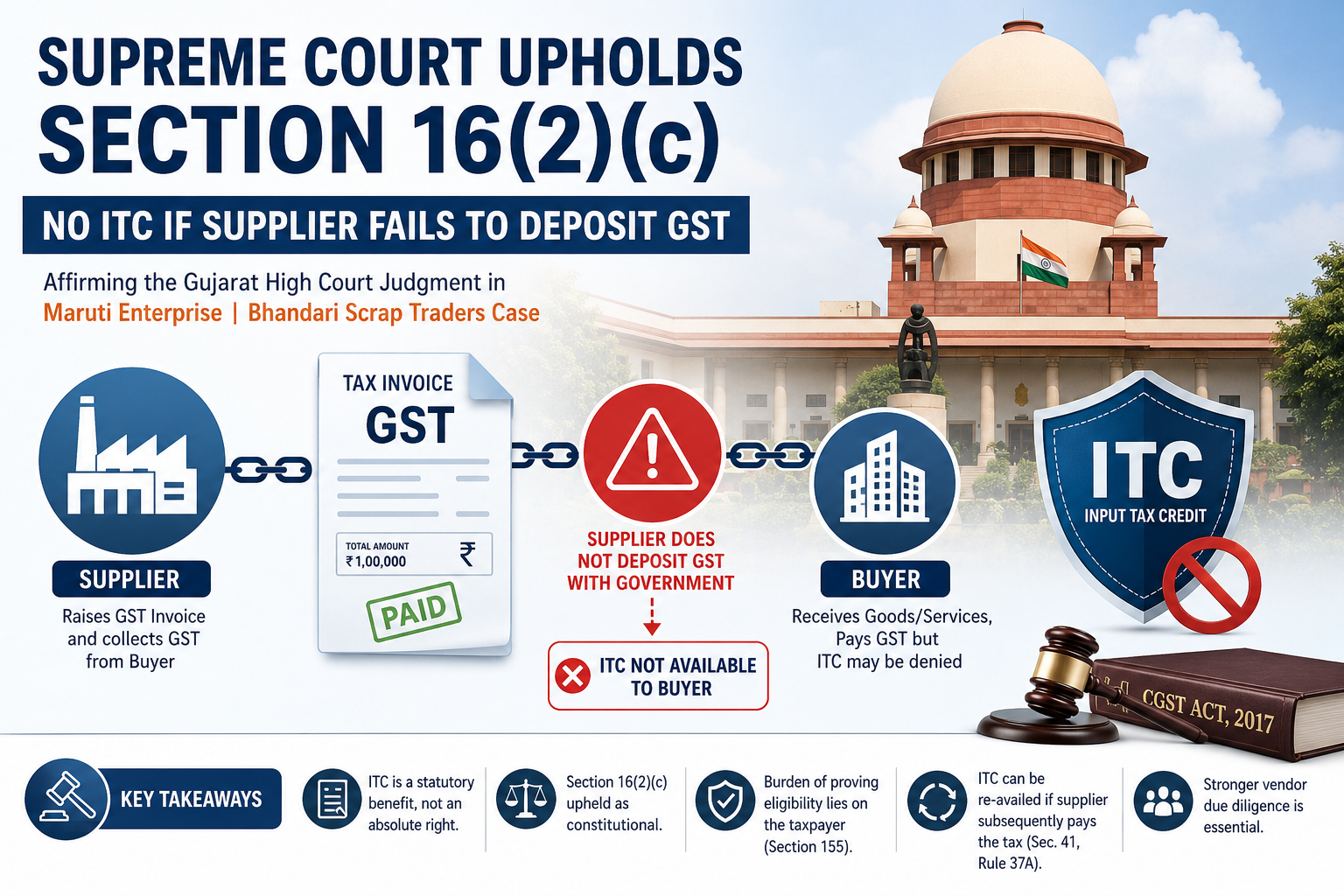
The Supreme Court of India, in Bhandari Scrap Traders v. Union of India & Ors., SLP (C) No. 23931 of 2026, decided on 24th July, 2026, has upheld the constitutional validity of Section 16(2)(c) of the Central Goods and Services Tax Act, 2017. A recipient of goods or services is not entitled to Input Tax Credit unless the tax charged on that supply has actually been paid to the Government by the supplier. The Court declined to read the provision down in favour of bona fide purchasers. The recipient’s remedy is to reverse the credit under Section 41(2) of the CGST Act read with Rule 37A of the CGST Rules, 2017, and to re-avail it once the supplier discharges the liability.
Key Takeaways
- Section 16(2)(c) of the CGST Act is constitutionally valid and will not be read down.
- Input Tax Credit is a statutory concession granted upon fulfilment of conditions, and not a vested right.
- Possession of a tax invoice, receipt of the goods or services, payment to the supplier through banking channels, and filing of returns are not by themselves sufficient. Actual payment of tax to the Government remains an independent and mandatory condition.
- The Delhi Value Added Tax line of authority, which protected bona fide purchasing dealers, does not apply to the GST regime because the statutory architecture differs materially.
- The recipient is not left without remedy. Reversal followed by re-availment is the prescribed statutory mechanism, and the Department retains the power to recover from the defaulting supplier under Sections 73 and 74 of the CGST Act.
- Vendor due diligence, monthly reconciliation of Form GSTR-2B, and protective contractual clauses are now commercial necessities rather than best practices.
Case at a Glance
| Particulars | Details |
|---|---|
| Case name | Bhandari Scrap Traders v. Union of India & Ors. and connected matters |
| Court | Supreme Court of India |
| Bench | Justice Sanjay Kumar and Justice Sanjeev Sachdeva |
| Proceeding | Special Leave Petition (Civil) No. 23931 of 2026 |
| Date of order | 24th July, 2026 |
| Neutral citation | 2026 LiveLaw (SC) 725 |
| Outcome | Special Leave Petitions dismissed |
| Judgment affirmed | Maruti Enterprise v. Union of India & Ors., R/Special Civil Application No. 18080 of 2023 and allied matters including R/Special Civil Application No. 749 of 2025, judgment dated 1st May, 2026 (Guj.) |
| Provision in issue | Section 16(2)(c) of the CGST Act, 2017 |
| Constitutional grounds urged | Articles 14, 19(1)(g), 265 and 300A of the Constitution of India |
| Counsel for the petitioners | Mr. Uchit Sheth, Adv.; Mr. Malak Manish Bhatt, AOR, and others |
| Effect | Denial of Input Tax Credit on supplier default is lawful |
1. What Section 16(2)(c) of the CGST Act Actually Says
Section 16(2) of the CGST Act opens with a non obstante clause and prescribes cumulative conditions, every one of which must be satisfied before Input Tax Credit becomes available to a registered person. The conditions are as follows.
- Clause (a): the registered person must be in possession of a tax invoice or debit note issued by a supplier registered under the CGST Act, or such other tax-paying document as may be prescribed.
- Clause (aa): the details of the invoice or debit note must have been furnished by the supplier in his statement of outward supplies, and must have been communicated to the recipient.
- Clause (b): the registered person must have received the goods or services, or both.
- Clause (ba): the details of input tax credit in respect of the said supply must not have been restricted in the auto-generated statement furnished under Section 38 of the CGST Act.
- Clause (c): subject to the provisions of Section 41 of the CGST Act, the tax charged in respect of such supply must have been actually paid to the Government, either in cash or through utilisation of input tax credit admissible in respect of the said supply.
- Clause (d): the registered person must have furnished the return under Section 39 of the CGST Act.
The commercial difficulty created by clause (c) is immediately apparent. The first five conditions lie within the recipient’s own knowledge and, to a substantial extent, within the recipient’s control. Clause (c) does not. Whether the supplier has in fact deposited the tax collected is a matter recorded in the supplier’s Form GSTR-3B and in the supplier’s electronic cash and credit ledgers, none of which is accessible to the recipient. The recipient therefore bears the consequence of a default that the recipient can neither foresee with certainty nor prevent.
It was precisely this asymmetry that formed the foundation of the constitutional challenge.
2. Facts of the Case: Bhandari Scrap Traders
M/s. Bhandari Scrap Traders, the petitioners, were denied Input Tax Credit on a single ground. Their suppliers had failed to deposit with the Government the tax that had been charged on the invoices and paid by the petitioners. The genuineness of the underlying transactions was not the foundation of the denial. The denial rested squarely on the operation of Section 16(2)(c) of the CGST Act.
The petitioners approached the Gujarat High Court, contending that the provision was arbitrary, ultra vires, and violative of Articles 14, 19(1)(g), 265 and 300A of the Constitution of India. The High Court decided the matter against them by its judgment dated 1st May, 2026 in Maruti Enterprise v. Union of India & Ors. Aggrieved by that judgment, the petitioners moved the Supreme Court by way of Special Leave Petitions.
3. The Taxpayer’s Case Before the Court
The petitioners advanced a structured constitutional and equitable case, the principal limbs of which were as follows.
First, it was contended that the genuineness of a transaction stands fully established once clauses (a), (aa), (b) and (ba) of Section 16(2) of the CGST Act have been satisfied. Clause (c) alone makes the entitlement contingent upon an act of a third party, namely the supplier, over which the recipient exercises no control and of which the recipient has no knowledge.
Second, reliance was placed on the maxim lex non cogit ad impossibilia, namely that the law does not compel the performance of the impossible. A recipient cannot be required to ensure the discharge of a statutory obligation cast upon another person, particularly where the recipient has no legal right of access to the supplier’s Form GSTR-3B.
Third, and centrally, the petitioners relied upon the Delhi Value Added Tax line of authority. Section 9(2)(g) of the Delhi Value Added Tax Act, 2004 is pari materia with Section 16(2)(c) of the CGST Act, in that it denied input tax credit to a purchasing dealer where the selling dealer failed to deposit the tax collected. In On Quest Merchandising India (P) Ltd. v. Government of NCT of Delhi, W.P.(C) No. 6093 of 2017, decided on 26th October, 2017, reported at (2017) 87 taxmann.com 179 (Del.) and 2018 (10) GSTL 182 (Del.), the Delhi High Court read that provision down so as to exclude from its operation a purchasing dealer who had bona fide transacted with a validly registered selling dealer against proper tax invoices. The High Court reasoned that the purchasing dealer was being asked to do the impossible, namely to anticipate which selling dealer would fail to deposit the tax collected.
The Special Leave Petition against that judgment was dismissed by the Supreme Court on 10th January, 2018 in Commissioner of Trade & Taxes, Delhi v. Arise India Ltd., reported at 2022 (60) GSTL 215 (SC). The same principle was subsequently approved in Commissioner of Trade & Tax, Delhi v. Shanti Kiran India (P) Ltd., Civil Appeal Nos. 2042 to 2047 of 2015 and 9902 of 2017, decided on 9th October, 2025, in which a bench of Justice Manoj Misra and Justice N. K. Singh dismissed the Revenue’s appeals and held that a bona fide purchasing dealer who has paid tax to a validly registered selling dealer cannot be denied input tax credit merely because that seller subsequently defaulted in depositing the tax with the Government.
Each of these three decisions was rendered under the Delhi Value Added Tax Act, 2004. Their application to the GST regime was always by analogy, and it is precisely that analogy which the Supreme Court has now rejected.
4. The Revenue’s Case
The Revenue met the challenge on the following footing.
Input Tax Credit is a concession conferred by statute and is not a vested right. It is therefore open to the Legislature to attach conditions to its availment, and the validity of such conditions is not to be tested by reference to commercial convenience.
Further, Section 16(2)(c) of the CGST Act cannot be read in isolation. It is expressly made subject to Section 41 of the CGST Act, and must be read together with Section 41(2), Section 53 and Section 155 of the CGST Act, and with Rule 37A of the CGST Rules, 2017. Under that combined scheme, the recipient reverses the credit upon default by the supplier and becomes entitled to re-avail the very same credit once the supplier discharges the tax. The consequence of supplier default under the CGST Act is therefore deferral of credit, and not permanent forfeiture.
On that basis, the Revenue submitted that no parity could be drawn with the Delhi Value Added Tax Act, 2004, which contained no comparable reversal and re-availment mechanism.
5. The Judgment of the Gujarat High Court in Maruti Enterprise
The Gujarat High Court upheld the constitutional validity of Section 16(2)(c) of the CGST Act and declined to read it down.
The reasoning of the High Court proceeded on the footing that Section 16(2)(c), when read along with Sections 41 and 53 of the CGST Act, adequately protects the interest of purchasing dealers against the denial of Input Tax Credit. The High Court held that Input Tax Credit is neither a constitutional nor a vested right, but a statutory concession subject to the conditions and restrictions prescribed under the Act, and that where the statute itself provides for reversal and re-availment of credit, the scheme cannot be characterised as amounting to double taxation so as to invalidate the provision.
Two further observations merit emphasis.
The first is that the recipient is not rendered remediless. The Revenue is empowered to recover the tax from the defaulting supplier under Sections 73 and 74 of the CGST Act, and the recipient may re-avail the reversed credit upon such recovery.
The second is a candid acknowledgement of the practical burden borne by honest purchasers. The High Court observed that the time has come for the Government to undertake a comprehensive re-evaluation of the difficulties faced by honest recipients, including the introduction of a robust, technology-driven mechanism for real-time verification of invoice-wise tax payments by suppliers, together with prompt recovery from erring suppliers. That observation is not a direction, and it confers no immediate relief, but it is a significant judicial signal to the GST Council and to the Central Board of Indirect Taxes and Customs.
6. What the Supreme Court Held
A bench of Justice Sanjay Kumar and Justice Sanjeev Sachdeva, by order dated 24th July, 2026, dismissed the batch of Special Leave Petitions and affirmed the judgment of the Gujarat High Court. The reasoning proceeded along the following lines.
On the Delhi Value Added Tax analogy. The Court held that the distinctions between the Delhi Value Added Tax Act, 2004 and the CGST Act, as brought out by the detailed analysis in the impugned judgment, together with the scheme of availment of Input Tax Credit under the GST regime, demonstrate that no parity can be drawn between the two enactments. A purchasing dealer under the CGST Act cannot be placed on the same footing as a bona fide purchasing dealer under the Delhi Value Added Tax Act where the supplier has failed to pay the requisite tax. The GST framework differs fundamentally from the earlier Value Added Tax regime, and protections developed under that earlier regime cannot automatically be imported into the GST system.
On the reversal and re-availment mechanism. The Court held that the Gujarat High Court had rightly referred to Section 41 as well as Sections 73 and 74 of the CGST Act in the context of the purchasing dealer being entitled to re-avail the reversed credit after the supplier is made to discharge the tax liability.
On validity. The Court held that the High Court was fully justified in concluding that no grounds had been made out to declare Section 16(2)(c) of the CGST Act unconstitutional or to read the provision down, and recorded its complete and respectful agreement with the view of the Gujarat High Court.
The Special Leave Petitions were accordingly dismissed.
7. Why the Delhi VAT Precedents No Longer Assist Under GST
The distinction drawn by the Court is best appreciated in tabular form.
| Feature | Delhi VAT Act, 2004 | CGST Act, 2017 |
|---|---|---|
| Condition of actual payment of tax by the seller | Section 9(2)(g) | Section 16(2)(c) |
| Statutory mechanism for reversal on seller default | Absent | Section 41(2) read with Rule 37A |
| Statutory right to re-avail credit on subsequent payment | Absent | Proviso to Section 41(2) |
| Consequence for the bona fide purchaser | Permanent loss of credit | Deferral of credit, with re-availment on payment |
| Judicial outcome | Read down to protect bona fide purchasers | Upheld without being read down |
The analytical core of the judgment is that the presence of a re-availment mechanism converts what would otherwise be a permanent expropriation into a temporary deferral. Once the loss ceases to be permanent in law, the constitutional objection under Articles 14, 19(1)(g), 265 and 300A of the Constitution of India loses much of its force, however severe the working capital consequences may be in practice.
The practical consequence for advisers is direct. Any reply, appeal or petition founded upon the Delhi Value Added Tax authorities in support of a bona fide purchaser argument must now be reframed, because the analogy on which that argument rested has been expressly rejected by the Supreme Court in the context of the CGST Act.
8. The Recipient’s Statutory Remedy: Section 41(2) and Rule 37A in Practice
The mechanism on which the entire judgment rests deserves to be set out precisely, because it is the mechanism that every recipient must now operate.
Section 41(2) of the CGST Act, as substituted by the Finance Act, 2022, requires that where the tax payable in respect of a supply has not been paid by the supplier, the credit availed by the recipient shall be reversed along with interest. The proviso permits re-availment of such credit once the supplier pays the tax, in the manner prescribed. That manner is prescribed by Rule 37A of the CGST Rules, 2017.
The operation of Rule 37A of the CGST Rules, 2017 is as follows.
- Where a supplier has furnished the details of an invoice in Form GSTR-1 or through the Invoice Furnishing Facility, but has not furnished the return in Form GSTR-3B for that tax period by the 30th day of September following the end of the financial year in which the credit was availed, the recipient must reverse that credit.
- The reversal must be effected in the return in Form GSTR-3B filed on or before the 30th day of November following the end of that financial year.
- Where the reversal is not effected by that date, the amount is payable together with interest under Section 50 of the CGST Act for the period from the date of availment until the date of payment.
- Where the supplier subsequently furnishes the return in Form GSTR-3B for the relevant tax period, the recipient may re-avail the credit in any return filed thereafter.
Two points of practical significance follow.
The first is that the re-availment permitted under the proviso to Section 41(2) of the CGST Act is a distinct statutory entitlement and, on a plain reading, is not circumscribed by the time limit prescribed under Section 16(4) of the CGST Act. That position is a matter of construction advanced in this article and is not the subject of any express holding in the present judgment. It should therefore be advanced as an argument and not asserted as settled law.
The second is that the burden of establishing eligibility to Input Tax Credit rests, under Section 155 of the CGST Act, upon the person claiming it. The recipient must therefore be in a position to demonstrate, from records, both the fact of reversal and the fact of the supplier’s subsequent payment.
Section 53 of the CGST Act, which obliges the transfer of funds to the destination State on inter-State supplies, supplies the fiscal rationale for the condition. Credit granted without a corresponding payment of tax disturbs the settlement architecture of the GST regime as a whole, and not merely the revenue of a single jurisdiction.
9. What This Means for Your Business
The judgment converts what many businesses treated as a defensible litigation position into a compliance obligation. The practical consequences are the following.
Working capital exposure is now certain rather than contingent. A recipient who has paid the tax component to a supplier and is then required to reverse the credit with interest bears the cost twice, once commercially and once fiscally, until the supplier pays.
Interest liability attaches to the recipient, not to the defaulter. The interest payable on delayed reversal under Rule 37A of the CGST Rules, 2017 is the recipient’s liability, notwithstanding that the default is entirely the supplier’s.
The bona fide purchaser defence is no longer available as a stand-alone ground. Arguments founded on genuineness of transaction, banking channel payments, and possession of documentation will not, without more, sustain a challenge to a demand raised under Section 16(2)(c) of the CGST Act.
Vendor selection has become a tax risk decision. The GST compliance profile of a supplier is now a commercial criterion of the same order as price and credit period.
10. The Compliance Framework You Should Implement Now
Before onboarding a supplier. Verify the GST registration status on the common portal. Examine the return filing history and confirm that Form GSTR-3B has been filed consistently. Record the verification on file, since Section 155 of the CGST Act places the evidentiary burden upon the recipient.
Every month. Reconcile Form GSTR-2B against the purchase register on an invoice-wise basis. Isolate every supplier whose invoices appear in Form GSTR-1 but who has not filed Form GSTR-3B. Escalate in writing to those suppliers immediately and retain the correspondence.
Before the 30th day of September each year. Prepare a list of all invoices in respect of which the supplier has not filed Form GSTR-3B for the relevant tax period. This is the population that will require reversal.
Before the 30th day of November each year. Effect the reversal in Form GSTR-3B in respect of that population, so as to avoid the interest consequence under Rule 37A of the CGST Rules, 2017.
On an ongoing basis. Maintain a re-availment register recording each reversed invoice, the supplier, the amount, the date of reversal, and the date on which the supplier subsequently files Form GSTR-3B. Credit that is reversed and never tracked is credit that is lost in substance even though it survives in law.
In every purchase contract. Incorporate the following protections. First, a representation and warranty that the supplier shall duly report the supply in Form GSTR-1 and discharge the corresponding tax through Form GSTR-3B within the prescribed period. Second, an indemnity in respect of any tax, interest and penalty suffered by the recipient by reason of the supplier’s default. Third, a right of retention of the tax component of the invoice until the credit is reflected as available in Form GSTR-2B, or in the alternative a right of set-off against future payments. Fourth, a right of termination on repeated default.
11. If You Have Already Received a Notice or Order
The judgment closes the constitutional avenue. It does not close every avenue. Where a demand has been raised on the footing of Section 16(2)(c) of the CGST Act, the grounds that remain available for examination include the following.
Whether the proceedings were initiated under the correct provision, since the invocation of Section 74 of the CGST Act requires the existence of fraud, wilful misstatement or suppression of facts, and a mere supplier default unaccompanied by any allegation of collusion may not sustain that jurisdiction.
Whether the notice satisfies the requirements of specificity, and whether it discloses the material on which the allegation of non-payment by the supplier is founded.
Whether the limitation prescribed under Section 73 or Section 74 of the CGST Act, as applicable, has been observed.
Whether an opportunity of personal hearing was afforded in accordance with Section 75(4) of the CGST Act.
Whether the credit in question has already been reversed under Rule 37A of the CGST Rules, 2017, in which event a fresh demand would result in double recovery.
Whether the Department has taken any step to recover the tax from the defaulting supplier, an inquiry that carries persuasive value even though it is not a legal precondition.
Whether the transaction period precedes the substitution of Section 41(2) of the CGST Act by the Finance Act, 2022 with effect from 1st October, 2022, and the insertion of Rule 37A of the CGST Rules, 2017, since the reasoning of the Supreme Court rests materially upon the availability of the reversal and re-availment mechanism. This last ground is an argument advanced in this article and has not been tested in any reported decision. It should be pleaded with candour as a distinguishing submission and not presented as established law.
Each of these is fact-dependent and requires examination of the notice, the order and the underlying records.
12. What to Watch Next
Two developments will shape this area over the coming months.
The first is whether the Government responds to the observation of the Gujarat High Court by introducing a real-time mechanism for verification of invoice-wise tax payments by suppliers. That would be the only durable solution to the difficulty faced by honest recipients, since it would allow a purchaser to know, at the time of transacting, whether the tax on a supply has in fact reached the Government.
The second is the manner in which appellate forums treat the substantial volume of pending matters founded upon the bona fide purchaser argument. Those matters will now require reframing around procedure, jurisdiction, limitation and quantification rather than around the equity of the purchaser’s position.
Frequently Asked Questions
Can my Input Tax Credit be denied if my supplier does not pay GST to the Government? Yes. Following the judgment of the Supreme Court in Bhandari Scrap Traders v. Union of India & Ors., Input Tax Credit may lawfully be denied to a recipient where the supplier has failed to actually pay the tax to the Government, notwithstanding that the recipient has paid the supplier in full.
Is Section 16(2)(c) of the CGST Act constitutionally valid? Yes. The Supreme Court has affirmed the judgment of the Gujarat High Court in Maruti Enterprise upholding its constitutional validity, and has declined to read the provision down in favour of bona fide purchasers.
Does it help that my transaction was genuine and that payment was made through banking channels? Not by itself. Genuineness establishes compliance with clauses (a), (aa), (b) and (ba) of Section 16(2) of the CGST Act. Clause (c) is a separate and cumulative condition requiring actual payment of tax to the Government, and all the conditions in Section 16(2) must be satisfied together. Under Section 155 of the CGST Act the burden of proving eligibility to Input Tax Credit rests upon the person claiming it.
Why do the Delhi VAT judgments protecting bona fide purchasers no longer help? Because the Supreme Court has held that no parity can be drawn between the Delhi Value Added Tax Act, 2004 and the CGST Act. The Delhi VAT Act contained no mechanism permitting a purchasing dealer to reverse and later re-avail the credit, so denial there meant permanent loss. Under the CGST Act, Section 41(2) read with Rule 37A of the CGST Rules, 2017 provides for reversal followed by re-availment, which makes the consequence a deferral rather than a forfeiture.
Is the Input Tax Credit lost permanently when the supplier defaults? No. Section 41(2) of the CGST Act requires reversal with interest where the supplier has not paid, and the proviso permits re-availment once the supplier pays. Rule 37A of the CGST Rules, 2017 prescribes the mechanism. The consequence is deferral of credit, together with an interest cost.
By what date must I reverse credit under Rule 37A? Where the supplier has not filed Form GSTR-3B for the relevant tax period by the 30th day of September following the end of the financial year in which the credit was availed, the credit must be reversed in Form GSTR-3B filed on or before the 30th day of November following the end of that financial year. Failure to do so attracts interest under Section 50 of the CGST Act.
Can I re-avail the credit after the time limit under Section 16(4) has expired? Re-availment under the proviso to Section 41(2) of the CGST Act is a distinct statutory entitlement and, on a plain reading, is not circumscribed by Section 16(4) of the CGST Act. This is a matter of construction rather than a settled holding, and the position should be documented carefully, since the burden of proving eligibility rests on the claimant under Section 155 of the CGST Act.
Can the Department recover the tax from my defaulting supplier instead of from me? The Department is empowered to recover from the defaulting supplier under Sections 73 and 74 of the CGST Act, and the Gujarat High Court relied upon that power in holding that the recipient is not remediless. The existence of that power does not, however, operate as a bar to reversal by the recipient in the first instance.
Does this judgment affect periods before Rule 37A was introduced? The judgment does not draw any express distinction by period. Since the reasoning rests materially upon the availability of the reversal and re-availment mechanism introduced with effect from 1st October, 2022, an argument may be available in respect of earlier periods, but it is untested and should be advanced as a distinguishing submission rather than as settled law.
What should I do if I have already received a notice denying credit on this ground? The constitutional challenge is no longer available, but grounds relating to the provision invoked, the specificity of the notice, limitation, denial of personal hearing under Section 75(4) of the CGST Act, and double recovery where the credit has already been reversed under Rule 37A remain open for examination on the facts. Professional advice should be obtained on the specific notice.
What is the single most effective protection available to a business? Monthly invoice-wise reconciliation of Form GSTR-2B against the purchase register, combined with retention of the tax component of the invoice until the credit is reflected as available. Prevention through contract and process is now considerably more effective than litigation after the demand is raised.
Conclusion
The judgment in Bhandari Scrap Traders v. Union of India & Ors. settles a question that has been in contest since the inception of the GST regime. The settled position is that availment of Input Tax Credit is conditional upon actual payment of tax by the supplier to the Government, and that the recipient’s remedy lies in reversal under Section 41(2) of the CGST Act read with Rule 37A of the CGST Rules, 2017, followed by re-availment once the supplier pays.
For the honest purchaser, the outcome is uncomfortable but not without remedy. The burden has shifted decisively from litigation to process. Businesses that build supplier compliance monitoring into their monthly close, and protection into their purchase contracts, will absorb this development without material loss. Those that do not will discover the cost of a supplier’s default only when a notice arrives, by which time the available grounds of challenge will have narrowed considerably.
LITIGATION AND COMPLIANCE CHECKLIST
- Obtain and review every notice or order in which credit has been denied under Section 16(2)(c) of the CGST Act, identifying in each case whether the proceedings were initiated under Section 73 or Section 74 of the CGST Act, and whether the ingredients of the provision invoked are made out on the record.
- Verify, in respect of every such matter, whether the limitation prescribed under the provision invoked has been observed, and whether an opportunity of personal hearing was afforded in accordance with Section 75(4) of the CGST Act.
- Ascertain, in respect of each disputed invoice, whether the credit has already been reversed under Rule 37A of the CGST Rules, 2017, so as to raise the objection of double recovery where applicable.
- Prepare, before the 30th day of September in each financial year, an invoice-wise statement of all supplies in respect of which the supplier has not furnished Form GSTR-3B, and effect the consequential reversal in the return filed on or before the 30th day of November following the end of that financial year.
- Maintain a re-availment register in respect of every reversed invoice, and monitor the supplier’s subsequent filing of Form GSTR-3B so that the entitlement under the proviso to Section 41(2) of the CGST Act is exercised.
- Incorporate into every purchase contract executed hereafter a GST compliance warranty, an indemnity in respect of tax, interest and penalty, a right of retention of the tax component pending reflection of credit in Form GSTR-2B, and a right of termination upon repeated default.
- Where an appeal is contemplated before the Appellate Authority under Section 107 of the CGST Act or before the Goods and Services Tax Appellate Tribunal, reframe the grounds so as to rest upon procedural infirmity, jurisdictional defect, limitation and quantification, rather than upon the bona fide purchaser argument, which no longer survives as a stand-alone ground.
Note on Verification of Authorities
The particulars of Bhandari Scrap Traders v. Union of India & Ors., including the case number, the date of the order, the composition of the bench and the operative holding, have been verified against contemporaneous law reports. The particulars of Maruti Enterprise, On Quest Merchandising India (P) Ltd., Arise India Ltd. and Shanti Kiran India (P) Ltd. have likewise been verified against primary or reported sources. Where a proposition advanced in this article represents the author’s construction rather than an express holding of any court, that has been stated expressly at the relevant place.
Practitioners intending to rely upon Bhandari Scrap Traders or Maruti Enterprise in proceedings should obtain the certified copy of the order and confirm the final reporter citation before filing, as is the ordinary practice in respect of recently pronounced decisions.
Disclaimer: This article is intended for general information and does not constitute legal or professional advice. The application of the provisions discussed depends upon the facts of each case. Readers are advised to obtain professional advice before acting upon any part of this article.