Introduction
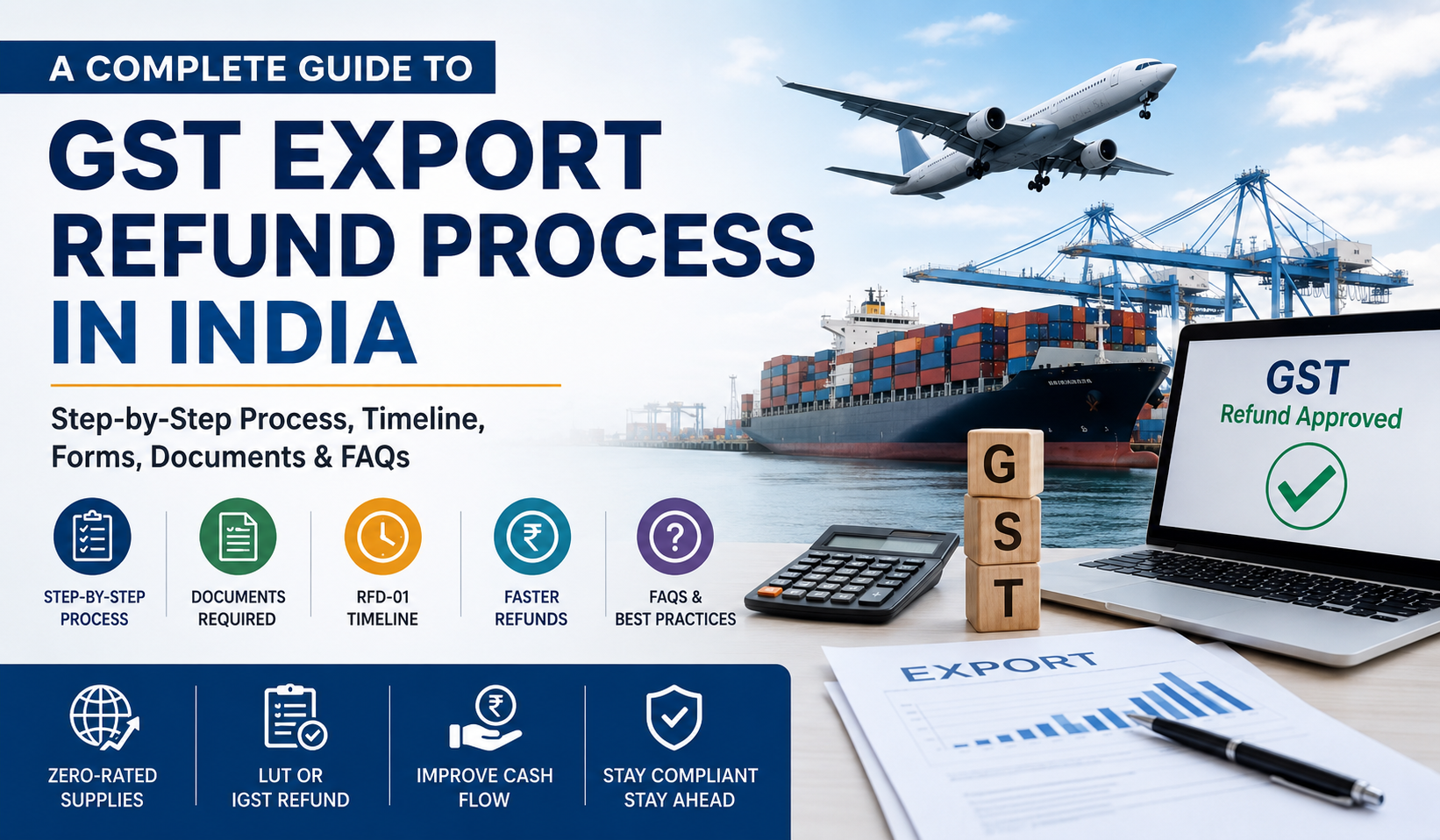
Exports are treated as zero-rated supplies under the Goods and Services Tax (GST) law. This allows eligible exporters to recover the GST paid on inputs and input services, thereby reducing the cost of exports and improving working capital. However, refund applications are often delayed due to documentation errors, mismatches in GST returns, incorrect shipping bill details, or non-compliance with procedural requirements.
This comprehensive guide explains the export refund process for both goods and services, the difference between exporting under a Letter of Undertaking (LUT) and with payment of IGST, the documents required, timelines, common mistakes, and practical tips to ensure faster refunds.
What is an Export Refund under GST?
Section 16 of the Integrated Goods and Services Tax (IGST) Act treats exports as zero-rated supplies. An exporter can either export under LUT without payment of IGST and claim a refund of unutilized Input Tax Credit (ITC), or export after payment of IGST and claim a refund of the tax paid.
The refund mechanism is intended to ensure that exports remain free from domestic taxes, making Indian products and services more competitive in the global market.
Two Methods of Claiming Export Refund
| Method | Tax at Export | Refund Claimed |
|---|---|---|
| Export under LUT | No IGST payable | Refund of accumulated ITC |
| Export with payment of IGST | IGST paid at export | Refund of IGST paid |
Step-by-Step Export Refund Process
Step 1 – Obtain LUT
Most exporters furnish a Letter of Undertaking (LUT) before making exports without payment of IGST. LUT is generally valid for one financial year and should be renewed annually.
Step 2 – Raise Export Invoice
The export invoice should contain all mandatory GST particulars along with the endorsement prescribed under the GST Rules where applicable.
Step 3 – File GSTR-1
Report export invoices accurately in GSTR-1. Invoice numbers, taxable value, shipping bill details and port codes should match the customs records.
Step 4 – File GSTR-3B
File GSTR-3B correctly and ensure the tax liability and ITC figures reconcile with GSTR-1 and books of account.
Step 5 – Complete Export
For goods, ensure the shipping bill, export general manifest (EGM), and customs documentation are complete. For services, ensure all conditions for export of services are satisfied, including receipt of consideration in convertible foreign exchange or Indian Rupees wherever permitted by RBI.
Step 6 – File Refund Application
Refund applications for accumulated ITC are generally filed online in Form GST RFD-01 along with the prescribed statements and declarations.
Step 7 – Processing by Authorities
The department verifies the application and supporting documents. Any deficiency memo or notice should be responded to promptly to avoid delays.
Documents Required
| Document | Purpose |
|---|---|
| Letter of Undertaking (LUT) | Export without payment of IGST |
| Export Invoices | Proof of supply |
| Shipping Bill | Customs export evidence |
| Export General Manifest (EGM) | Confirmation of export |
| GSTR-1 & GSTR-3B | GST compliance |
| FIRC/BRC (where applicable) | Evidence of foreign remittance |
| Refund Statements | Supporting schedules |
GST Refund Timeline (RFD-01 Process)
| Stage | Action | Approximate Timeline |
|---|---|---|
| Day 0 | Export completed and GST returns filed | Day 0 |
| Application | Refund application in Form GST RFD-01 filed on GST Portal | Same Day |
| Scrutiny | Proper Officer scrutinizes application. If deficiencies are noticed, Deficiency Memo (RFD-03) may be issued. | Within 15 Days |
| Provisional Refund | Eligible exporters may receive provisional refund of up to 90% subject to statutory conditions. | Within 7 Days from acknowledgement |
| Verification | Verification of GST returns, ITC, Shipping Bill, EGM, BRC/FIRC (where applicable) and supporting documents. | Varies |
| Final Order | Refund Sanction/Rejection Order (RFD-06) | Normally within 60 Days from receipt of complete application |
| Payment | Payment Order (RFD-05) and refund credited to registered bank account. | Generally within a few days after sanction |
Interest on Delayed Refund: Under Section 56 of the CGST Act, interest may become payable if the refund is not sanctioned within the prescribed period of 60 days from receipt of a complete application, subject to the provisions of the Act.
Common Reasons for Refund Rejection or Delay
- Mismatch between GSTR-1 and shipping bill.
- Incorrect invoice details.
- Non-filing or delayed filing of GST returns.
- Incorrect refund period.
- Expired LUT.
- Mismatch in ITC claimed.
- Incomplete documentation.
- Incorrect bank account details.
- Failure to respond to departmental notices.
Best Practices
- Reconcile GST returns every month.
- Maintain complete export documentation.
- Review shipping bill details before filing.
- Apply for refunds regularly instead of accumulating claims.
- Maintain proper working papers for ITC.
Frequently Asked Questions
1. Is LUT compulsory?
No. Exporters may export with payment of IGST or under LUT, subject to the applicable provisions.
2. Can services exporters claim refund?
Yes, provided the legal conditions for export of services are satisfied.
3. Can refunds be filed monthly?
Yes, subject to eligibility and applicable procedural requirements.
4. What is the time limit for claiming refund?
Refund applications should be filed within the limitation period prescribed under Section 54 of the CGST Act, read with the applicable rules and notifications.
5. Why are export refunds delayed?
The most common reasons include mismatched return data, incorrect documentation, customs discrepancies and delayed responses to departmental communications.
Conclusion
GST export refunds play a vital role in improving exporters’ cash flow. Proper documentation, timely filing of GST returns, accurate reporting and periodic reconciliations significantly reduce the chances of rejection or delay. Businesses involved in export of goods or services should periodically review their compliance processes to ensure smooth and timely refund processing.
Need Professional Assistance?
Bansal S S & Co., Chartered Accountants assists exporters with LUT filing, GST registrations, export refund applications, reconciliation of GST returns, departmental notices, litigation support and FEMA advisory services. A professionally reviewed refund application can help minimise delays and improve compliance.