Latest GSTN Update
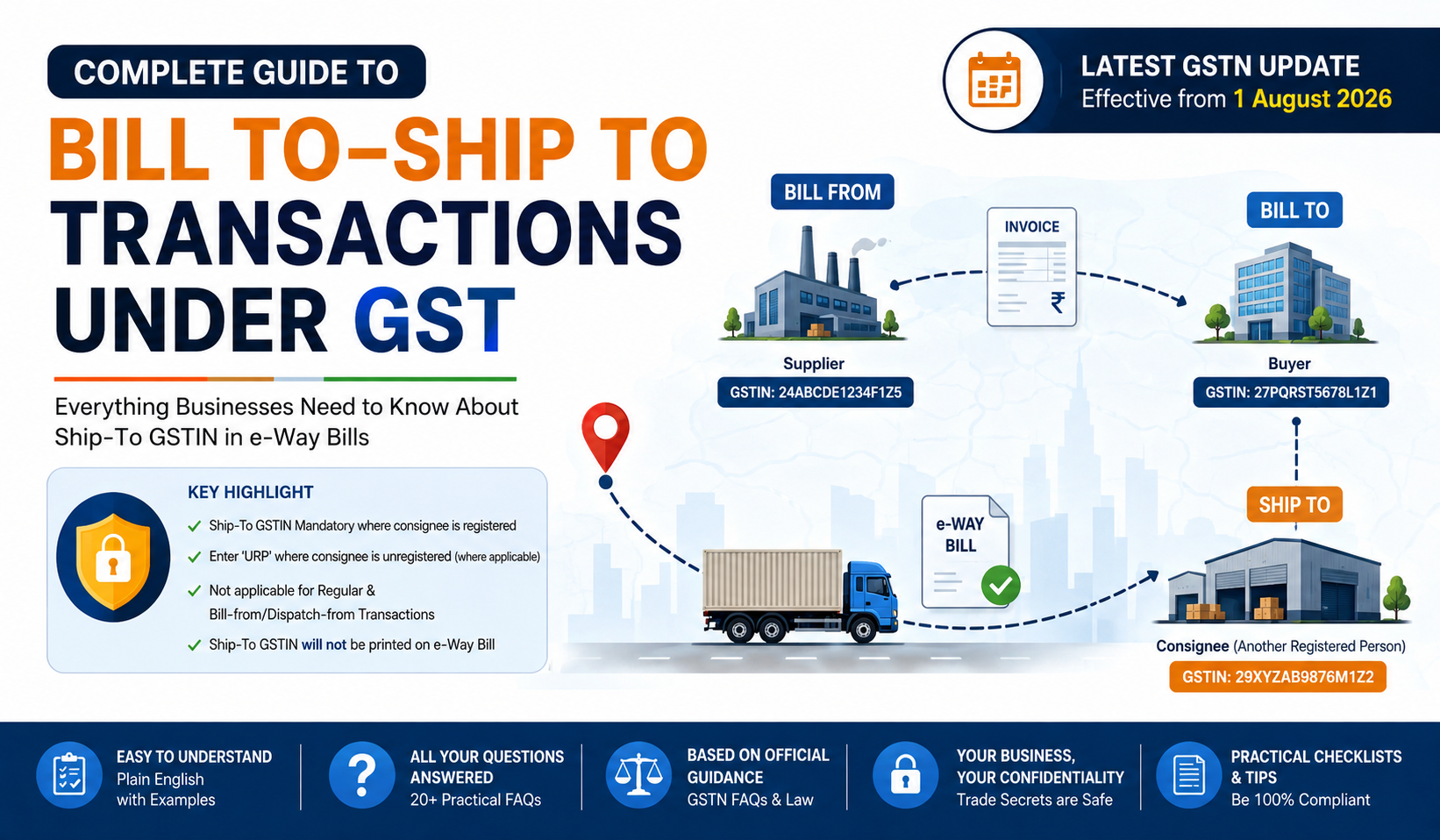
Effective 1 August 2026, Ship-To GSTIN is required to be captured as a mandatory data element where the Ship-To party is registered in Bill-To/Ship-To and Combination transactions. If the Ship-To party is unregistered, ‘URP’ may be entered wherever applicable. This requirement does not apply to Regular transactions or Bill-from/Dispatch-from transactions.
Why was this change introduced?
GSTN introduced this enhancement to improve traceability of goods movement, strengthen the audit trail and enable better system-based verification while protecting commercial confidentiality.
Identify Your Transaction
| Transaction | Ship-To GSTIN? | Example |
| Regular | No | A sells to B and delivers to B |
| Bill-To/Ship-To | Yes (if consignee registered; otherwise URP where applicable) | A bills B, ships to C |
| Bill-from/Dispatch-from | No | A bills B, goods move from C to B |
| Combination | Yes (if consignee registered; otherwise URP where applicable) | A bills B, goods move from C to D |
Biggest Confusion Solved
If the goods are delivered to the buyer’s own warehouse or additional place of business, it is NOT a Bill-To/Ship-To transaction. Do not choose the Bill-To/Ship-To option merely because the delivery address differs. In a genuine Bill-To/Ship-To transaction, the Bill-To party and Ship-To party are different persons.
Which GSTIN goes where?
| Portal Field | Enter |
| Bill From | Supplier GSTIN |
| Bill To | Invoice recipient GSTIN |
| Ship To | Actual consignee GSTIN (or URP where applicable) |
| Dispatch From | Actual dispatch location |
| Delivery Address | Actual place where goods will reach |
Will my trade secrets be leaked?
No. According to the GSTN FAQ, the Ship-To GSTIN will not be printed on the e-Way Bill, will not be available through GET EWB APIs and will be visible only to authorised officers. This protects commercial confidentiality.
If you do not want to share your customer GSTIN
The buyer may generate the e-Way Bill themselves if they do not wish to disclose the Ship-To GSTIN to the supplier due to confidentiality concerns.
Common Mistakes
- Treating a regular transaction as Bill-To/Ship-To.
- Entering the same GSTIN in Bill-To and Ship-To fields.
- Sending Ship-To GSTIN in a Regular transaction.
- Ignoring URP where applicable.
- Mismatch between invoice and e-Way Bill details.
Frequently Asked Questions
Is Ship-To GSTIN mandatory in every transaction?
No. Only in applicable Bill-To/Ship-To and Combination transactions.
Can Bill-To GSTIN and Ship-To GSTIN be the same?
No, not in a Bill-To/Ship-To transaction.
Will Ship-To GSTIN appear on the printed e-Way Bill?
No.
Can the transporter generate the e-Way Bill?
Yes, if required details are available.
Can the buyer generate the e-Way Bill?
Yes, especially where confidentiality is a concern.
What should be entered if the consignee is unregistered?
URP, wherever applicable.
Does this apply to exports?
Special export scenarios are covered by GSTN; export-linked locations may use URP where applicable.
Should Ship-To GSTIN be sent in Regular transactions?
No.
Need Professional Assistance?
Bansal S S & Co. assists businesses with GST compliance, e-Way Bills, export advisory, litigation and GST audits. To Read the Complete FAQ , Click on https://services.gst.gov.in/services/advisoryandreleases/read/667