Eligibility, 0.1% GST Rate, RCMC, Conditions, Documentation & Compliance
India’s export sector is a key driver of economic growth, and merchant exporters play a vital role in connecting domestic manufacturers with international markets. To encourage exports and reduce the working capital burden on exporters, the Government has introduced a concessional GST rate of 0.1% on specified domestic procurements made by eligible merchant exporters, subject to compliance with prescribed conditions.
While the benefit appears straightforward, many exporters inadvertently lose the concession due to procedural lapses, incomplete documentation, or non-compliance with statutory requirements.
This comprehensive guide explains everything a merchant exporter needs to know—from eligibility and Registration-cum-Membership Certificate (RCMC) requirements to documentation, GST compliance, conditions, and frequently asked questions.
What is a Merchant Exporter?
A merchant exporter is a person or business that purchases goods from manufacturers, wholesalers or traders in India and exports those goods outside India.
Unlike businesses that manufacture products themselves, merchant exporters procure finished goods and export them under their own Import Export Code (IEC).
Legal Provision for Concessional GST
The concessional GST rate is available under:
Notification No. 40/2017-Central Tax (Rate) dated 23 October 2017, along with the corresponding State GST Notifications, as amended from time to time.
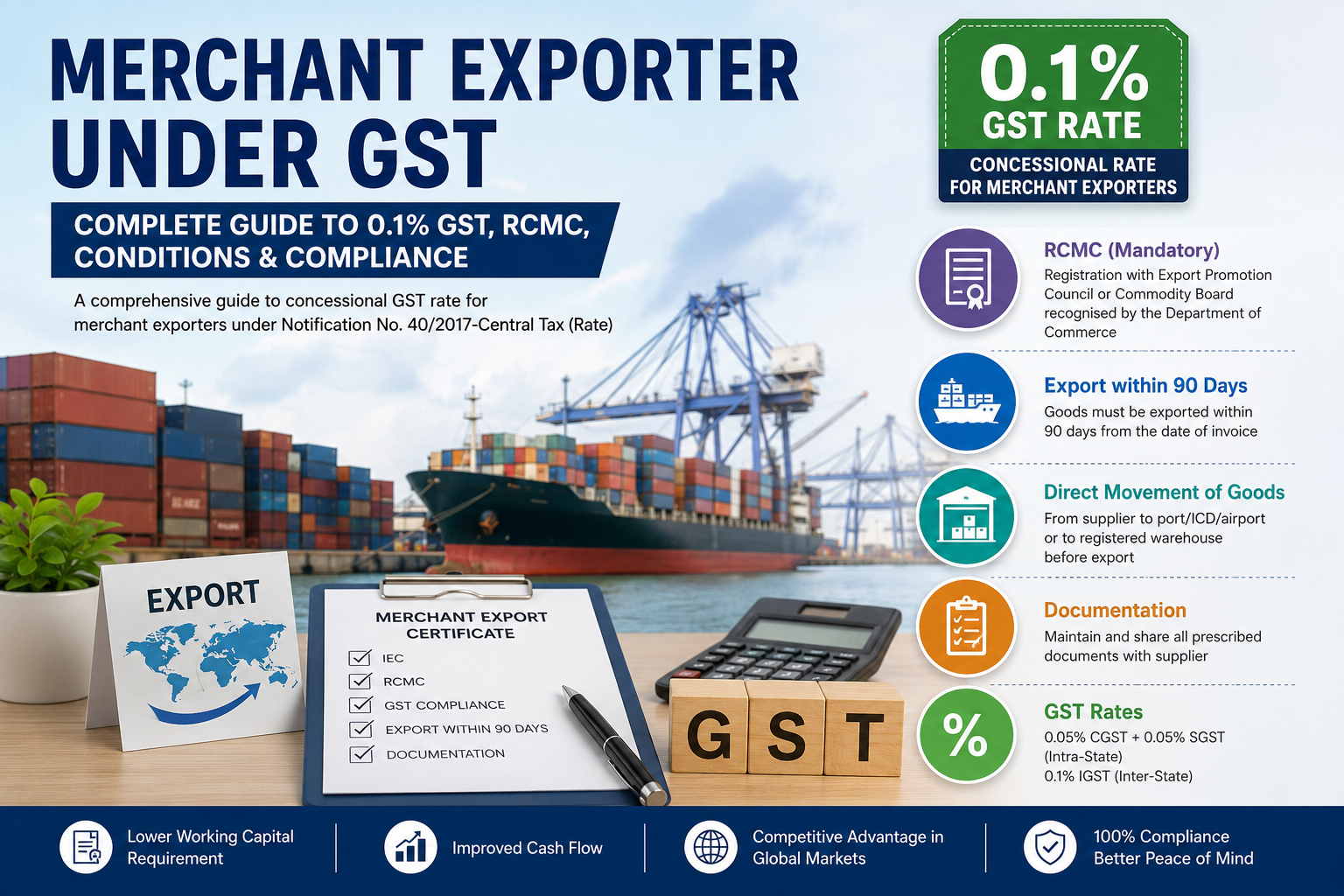
The notification permits eligible merchant exporters to procure taxable goods at:
- 0.05% CGST + 0.05% SGST for intra-State supplies, or
- 0.1% IGST for inter-State supplies,
subject to fulfillment of all prescribed conditions.
Who Can Avail the 0.1% GST Benefit?
A registered person may procure goods at the concessional GST rate if:
- They are registered under GST.
- They are engaged in exporting goods.
- They possess a valid Import Export Code (IEC), which is mandatory for undertaking exports.
- They are registered with an Export Promotion Council (EPC) or a Commodity Board recognised by the Department of Commerce and hold a valid Registration-cum-Membership Certificate (RCMC).
- They satisfy all other conditions prescribed under Notification No. 40/2017-Central Tax (Rate), as amended.
GST Rate Applicable
| Type of Supply | GST Rate |
|---|---|
| Intra-State Supply | 0.05% CGST + 0.05% SGST |
| Inter-State Supply | 0.1% IGST |
Conditions to Avail the Concessional GST Rate
1. Registration with Export Promotion Council (RCMC)
The merchant exporter must be registered with an Export Promotion Council (EPC) or a Commodity Board recognised by the Department of Commerce and hold a valid Registration-cum-Membership Certificate (RCMC).
This is a mandatory condition prescribed under the notification for availing the concessional GST rate.
2. Goods Must Be Exported
The goods procured at the concessional GST rate must be exported out of India.
3. Export Within 90 Days
The goods must be exported within 90 days from the date of issue of the supplier’s tax invoice.
Failure to export within the prescribed period may result in recovery of the differential GST along with applicable interest.
4. Goods Should Be Moved Directly
The goods should ordinarily be moved:
- directly from the supplier’s premises to the port, airport, Inland Container Depot (ICD), Land Customs Station or registered warehouse; or
- first to a registered warehouse and thereafter to the port for export.
5. Registered Warehouse (Where Applicable)
Where goods are first transported to a warehouse, the warehouse should be registered with the jurisdictional GST officer in accordance with the notification, and proper records of receipt and dispatch should be maintained.
6. Endorsement by Warehouse Operator
Where goods are received in a warehouse, the warehouse operator should endorse the receipt of goods on the supplier’s tax invoice.
7. Furnishing Endorsed Invoice to Supplier
The merchant exporter should provide a copy of the endorsed invoice to the supplier as proof that the goods have been received in the warehouse.
8. Intimation to the Jurisdictional GST Officer
The merchant exporter should provide a copy of the purchase order placed on the registered supplier to the jurisdictional GST officer having jurisdiction over the supplier.
This is one of the procedural requirements prescribed under the notification and should be complied with promptly.
9. Furnishing Export Documents to Supplier
After export, the merchant exporter should provide copies of the following documents to the supplier:
- Shipping Bill or Bill of Export
- Export Invoice
- Bill of Lading or Airway Bill (where applicable)
- Export General Manifest (EGM) or other proof of export
- Other supporting export documents, wherever required
These documents enable the supplier to establish compliance with the notification.
Merchant Export Certificate
A commonly used document in practice is the Merchant Export Certificate (also referred to as a Merchant Export Declaration).
This declaration is issued by the merchant exporter to the domestic supplier confirming that the goods are intended for export under the concessional GST notification.
The certificate generally contains:
- Merchant Exporter’s Name
- GSTIN
- IEC
- RCMC Details
- Supplier Name and GSTIN
- Purchase Order Details
- Invoice Details
- Description of Goods
- Declaration that the goods are intended for export
- Undertaking to export within the prescribed time limit
- Declaration regarding compliance with Notification No. 40/2017-Central Tax (Rate)
Although no statutory format has been prescribed, the declaration should clearly establish eligibility under the notification and be properly signed.
Documents Required
Every merchant exporter should maintain proper records including:
- GST Registration Certificate
- Import Export Code (IEC)
- Registration-cum-Membership Certificate (RCMC)
- Purchase Orders
- Supplier Tax Invoices
- Merchant Export Certificate / Declaration
- E-Way Bills (where applicable)
- Transport Documents
- Warehouse Records (if applicable)
- Shipping Bills
- Export Invoices
- Bills of Lading / Airway Bills
- Export General Manifest (EGM), where applicable
- Bank Realisation Certificate (BRC) / e-BRC, wherever applicable
Proper documentation is essential during GST audits and departmental verification.
Is LUT Required?
The concessional procurement at 0.1% GST and the requirement of Letter of Undertaking (LUT) are two separate concepts.
Where exports are made without payment of IGST, the exporter should ordinarily furnish a valid LUT under the IGST Act, subject to eligibility.
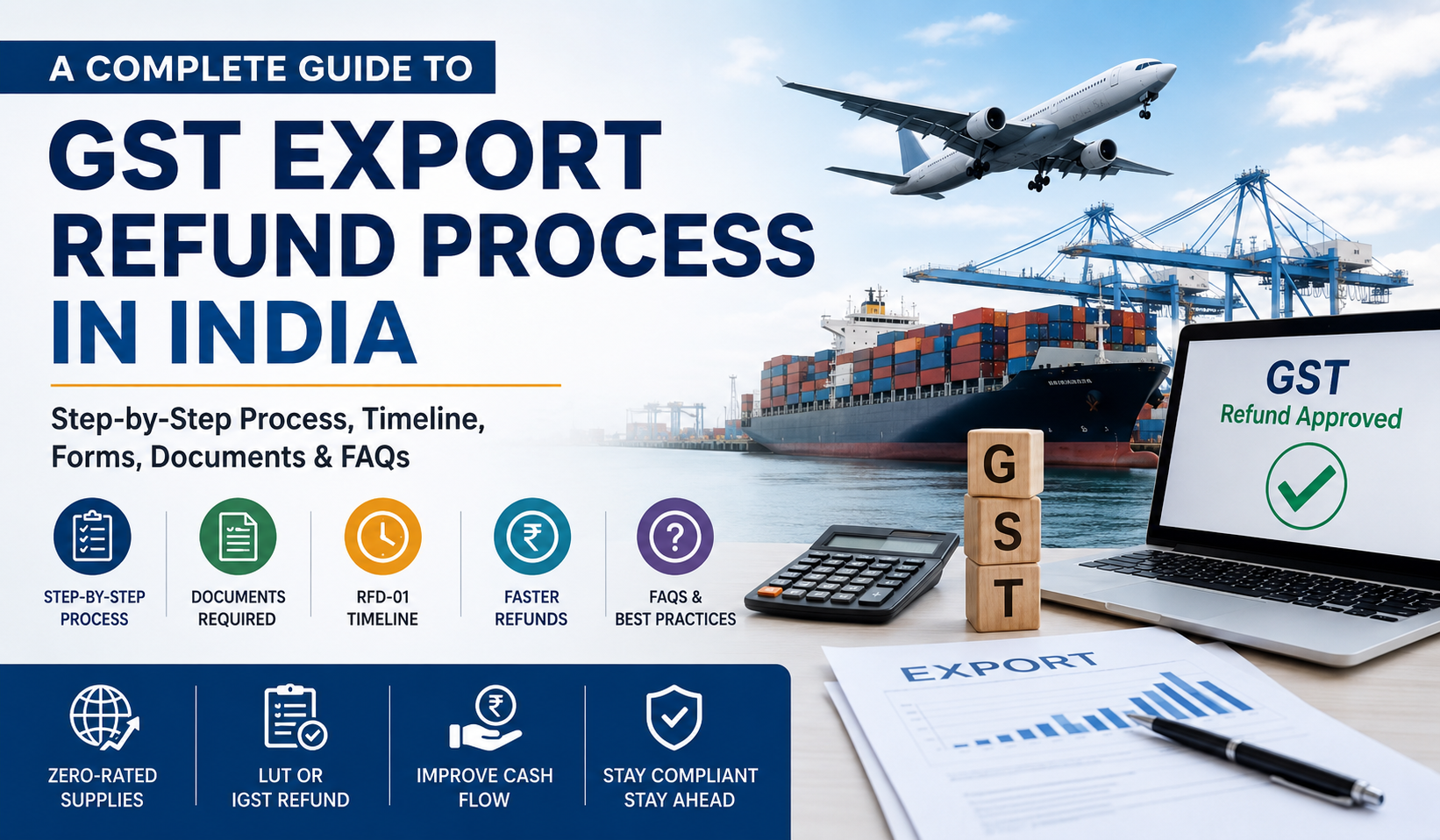
Alternatively, exports may be made on payment of IGST with refund claimed subsequently, where applicable.
Can Input Tax Credit (ITC) Be Claimed?
Yes.
Merchant exporters may claim Input Tax Credit on eligible inward supplies in accordance with the provisions of the GST law.
The concessional procurement of goods at 0.1% does not by itself restrict the availment of eligible ITC on other inward supplies.
Consequences of Non-Compliance
Failure to comply with the prescribed conditions may result in:
- Recovery of the differential GST.
- Liability to pay applicable interest.
- Denial of concessional procurement benefits.
- Possible disputes during GST assessment or audit.
Both the merchant exporter and the supplier should therefore ensure complete compliance with the notification.
Advantages of the Merchant Export Scheme
The concessional GST scheme offers several benefits, including:
- Reduced working capital blockage.
- Lower procurement costs.
- Improved cash flow.
- Enhanced competitiveness in international markets.
- Simplified procurement from domestic suppliers.
- Better liquidity for exporters.
Common Mistakes
Some of the most common errors include:
- Not obtaining or renewing the RCMC.
- Failure to export within 90 days.
- Charging incorrect GST on procurement.
- Missing jurisdictional officer intimation.
- Incomplete documentation.
- Failure to preserve warehouse records.
- Missing proof of export.
- Poor reconciliation between purchase invoices and export documents.
Frequently Asked Questions (FAQs)
Can any GST-registered person become a merchant exporter?
Yes, provided the business is engaged in exporting goods and satisfies all conditions prescribed under the notification, including holding a valid RCMC.
Is RCMC mandatory?
Yes. Registration with an Export Promotion Council or Commodity Board through a valid Registration-cum-Membership Certificate (RCMC) is one of the prescribed conditions for availing the concessional GST rate under the notification.
Is the concessional GST rate available on services?
No. The notification applies only to eligible goods.
Can goods be stored before export?
Yes. Goods may be stored in a registered warehouse before export, subject to compliance with the prescribed conditions.
Is there a prescribed Merchant Export Certificate format?
No. The notification does not prescribe a standard format. However, exporters generally issue a declaration containing all relevant particulars and an undertaking regarding export compliance.
What happens if goods are not exported within 90 days?
The concessional benefit may be denied, resulting in recovery of the differential GST along with applicable interest.
Is LUT compulsory for merchant exporters?
If exports are made without payment of IGST, an LUT is ordinarily required, subject to the provisions of the GST law.
Conclusion
The concessional 0.1% GST procurement scheme is an important incentive for merchant exporters, enabling them to reduce working capital requirements and remain competitive in global markets. However, the benefit is available only upon strict compliance with the conditions prescribed under Notification No. 40/2017-Central Tax (Rate), as amended, including obtaining an RCMC, maintaining complete documentation, exporting goods within the prescribed timeline, and following all procedural requirements.
Businesses engaged in exports should implement a robust compliance mechanism to ensure that every concessional procurement is properly documented and supported by evidence. This not only safeguards the GST benefit but also minimises the risk of disputes during departmental audits and assessments.
Need Expert Assistance?
At Bansal S S & Co., Chartered Accountants, we assist businesses with:
- Merchant Export Advisory
- GST Compliance for Exporters
- RCMC & Export Documentation Guidance
- LUT Filing
- GST Refunds
- Export Incentive Advisory
- GST Notices & Litigation
- End-to-End Export Compliance
If you require professional assistance with merchant export compliance or GST advisory, feel free to contact our team.