
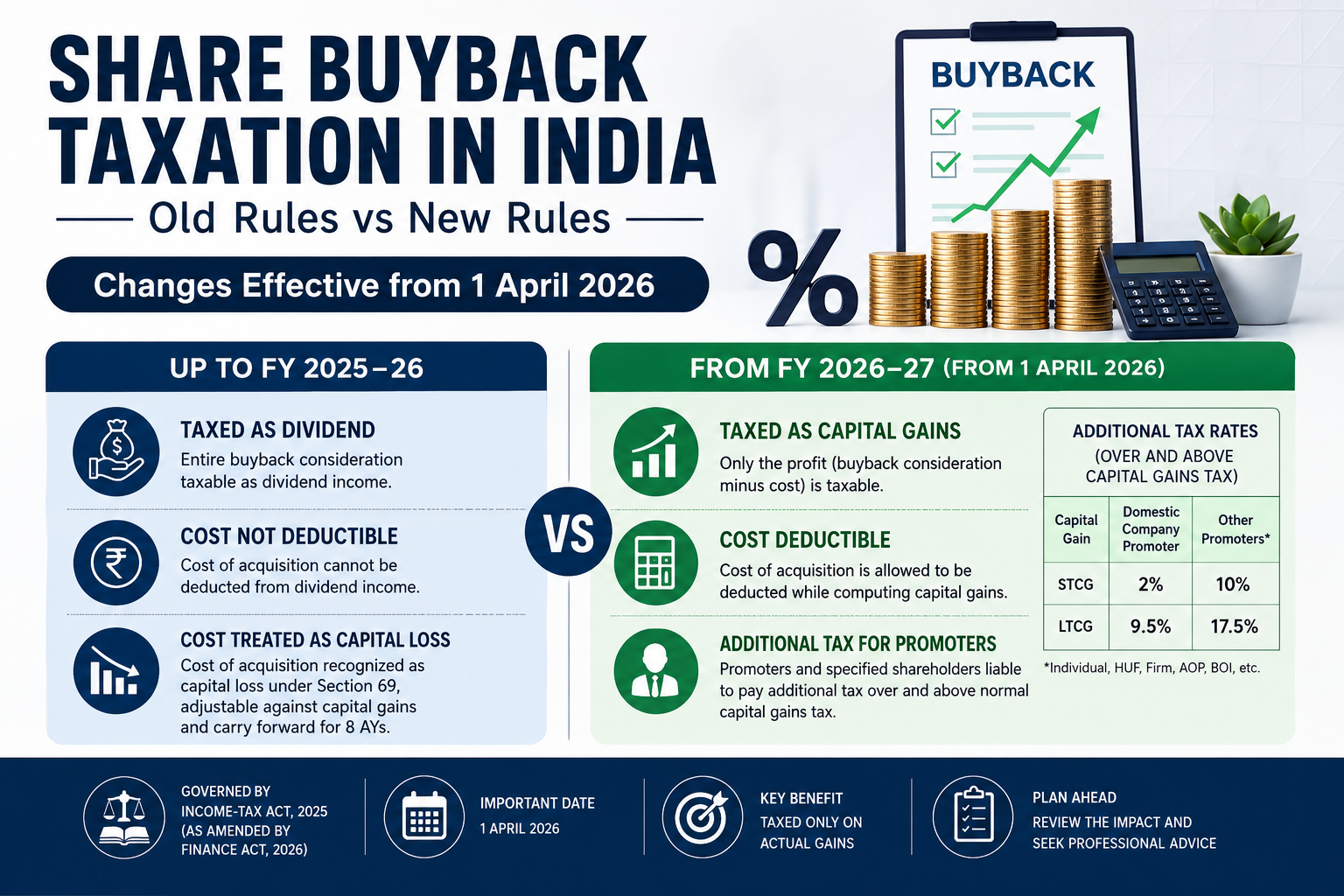
Understand how share buybacks are taxed under the Income-tax Act, 2025, the transition from dividend taxation to capital gains taxation, and the additional tax applicable to promoters from 1 April 2026.
Introduction
Share buybacks have become an increasingly popular method for companies to return surplus funds to shareholders while optimizing their capital structure. However, the tax implications of a buyback have undergone significant changes in recent years.
Under the provisions applicable for FY 2025–26, the entire amount received by a shareholder on buyback is generally treated as dividend income. However, from 1 April 2026, the Income-tax Act, 2025, as amended by the Finance Act, 2026, introduces a completely different framework whereby buyback proceeds are generally taxed as capital gains. Additionally, promoters and certain significant shareholders may be liable to pay an additional income-tax.
Whether you are a promoter, investor, startup founder, company director or tax professional, understanding these provisions is essential for accurate tax planning and compliance.
This article explains both regimes in a practical and easy-to-understand manner.
What is a Share Buyback?
A share buyback (also known as a share repurchase) is a transaction in which a company purchases its own shares from existing shareholders at a predetermined price.
Companies typically undertake buybacks to:
- Return excess cash to shareholders
- Improve Earnings Per Share (EPS)
- Optimise their capital structure
- Provide liquidity or an exit opportunity to shareholders
- Enhance shareholder value
The tax treatment depends primarily on when the buyback takes place.
Share Buyback Taxation up to FY 2025–26
For buybacks undertaken before 1 April 2026, the taxation framework is governed by the Income-tax Act, 2025, wherein the buyback consideration is treated differently from an ordinary sale of shares.
1. Entire Buyback Consideration is Treated as Dividend
The entire amount received by the shareholder from the company on buyback is treated as dividend income.
Accordingly:
- The whole amount received becomes taxable.
- Tax is payable by the shareholder at the applicable income-tax slab rate.
- The normal TDS provisions applicable to dividend income also apply.
Unlike a normal sale of shares, taxation is not based on the actual profit earned.
2. Cost of Acquisition Cannot Be Deducted
One of the most significant features of the existing regime is that the shareholder cannot deduct the cost of acquisition while computing taxable dividend income.
For example:
Suppose an investor purchased shares for ₹5,00,000 and subsequently tenders those shares in a buyback for ₹8,00,000.
Under the existing regime:
- Amount received = ₹8,00,000
- Cost of acquisition = Not deductible
- Taxable dividend income = ₹8,00,000
Thus, tax is levied on the entire consideration, not merely on the actual gain.
3. Treatment of Cost of Acquisition
Although the cost of acquisition is not deductible while computing dividend income, it is recognised separately as a capital loss under Section 69 of the Income-tax Act, 2025.
This capital loss:
- may be adjusted against eligible capital gains;
- may be carried forward for eight assessment years, subject to the prescribed conditions under the Act.
4. Reporting in the Income Tax Return
For FY 2025–26, shareholders generally report:
- the buyback proceeds under Income from Other Sources (Dividend Income); and
- the capital loss separately under the Capital Gains Schedule for carry forward or set-off, wherever applicable.
Taxation of Share Buybacks from 1 April 2026
The Finance Act, 2026 fundamentally changes the taxation of buybacks.
Instead of taxing the entire consideration as dividend, the Income-tax Act, 2025 now taxes only the actual capital gain arising on the transaction.
This represents a significant shift towards a more equitable taxation mechanism.
Capital Gains Become Taxable
Under Section 69(1) of the Income-tax Act, 2025:
Capital Gain = Buyback Consideration − Cost of Acquisition
Accordingly:
- the cost of acquisition is allowed as a deduction;
- only the actual gain becomes taxable.
This restores taxation based on the real economic profit earned by the shareholder.
Tax Rates for Non-Promoter Shareholders
For shareholders who are not covered under the promoter provisions, the applicable tax rates are:
| Nature of Gain | Tax Rate |
|---|---|
| Long-Term Capital Gain (LTCG) | 12.5% |
| Short-Term Capital Gain (STCG) | 20% |
These are the standard capital gains tax rates applicable under the Income-tax Act, 2025.
Additional Tax for Promoters and Significant Shareholders
The Finance Act, 2026 also introduces an additional income-tax applicable to certain promoters and significant shareholders.
This additional tax is payable over and above the normal capital gains tax.
Who is a Promoter?
For listed companies, promoter shall have the meaning assigned under the applicable SEBI Regulations.
For unlisted companies, promoter includes:
- a promoter as defined under Section 2(69) of the Companies Act, 2013; or
- any person who holds, directly or indirectly, more than 10% of the shareholding in the company.
Additional Tax Rates
| Capital Gains | Domestic Company Promoter | Other Promoters (Individual / HUF / Firm / AOP / BOI) |
|---|---|---|
| Short-Term Capital Gain | 2% | 10% |
| Long-Term Capital Gain | 9.5% | 17.5% |
These rates are charged in addition to the normal capital gains tax computed under Section 69(1).
Old Regime vs New Regime – Comparison
| Particulars | Up to FY 2025–26 | From FY 2026–27 |
|---|---|---|
| Nature of Income | Dividend Income | Capital Gains |
| Tax Base | Entire Buyback Consideration | Consideration minus Cost of Acquisition |
| Cost of Acquisition | Not Deductible | Fully Deductible |
| Tax Rate | Applicable Slab Rate | LTCG – 12.5% / STCG – 20% (subject to promoter provisions) |
| Capital Loss | Cost recognised as capital loss under Section 69 | Normal capital gains provisions apply |
Practical Illustration
Assume the following:
- Shares purchased = 100
- Purchase price = ₹50 per share
- Total cost = ₹5,000
Later:
- Shares tendered = 40
- Buyback price = ₹80 per share
- Total consideration = ₹3,200
Under FY 2025–26
Dividend Income = ₹3,200
Tax is payable on the entire ₹3,200.
The cost of ₹2,000 attributable to the shares tendered cannot be deducted while computing dividend income.
From 1 April 2026
Cost attributable to 40 shares
= 40 × ₹50
= ₹2,000
Capital Gain
= ₹3,200 − ₹2,000
= ₹1,200
Only ₹1,200 is taxable as capital gains.
This demonstrates how the revised provisions tax only the actual gain rather than the entire consideration.
Advantages of the New Regime
The revised framework offers several practical benefits:
- Taxation is based on actual economic gains.
- Cost of acquisition is allowed as a deduction.
- The computation aligns with the general principles of capital gains taxation.
- The possibility of taxing the entire consideration irrespective of actual profit is eliminated.
- The taxation mechanism becomes more rational and transparent.
However, promoters and specified shareholders must evaluate the impact of the additional income-tax introduced by the Finance Act, 2026.
Frequently Asked Questions (FAQs)
Is share buyback taxable in India?
Yes. The tax treatment depends on the applicable law for the relevant financial year. Up to FY 2025–26, buyback proceeds are generally taxed as dividend. From 1 April 2026, they are generally taxed as capital gains.
Can I deduct the purchase cost of my shares?
For buybacks before 1 April 2026, the cost of acquisition cannot be deducted while computing dividend income. Instead, it is recognised as a capital loss under Section 69 of the Income-tax Act, 2025.
From 1 April 2026, the cost of acquisition is deductible while computing capital gains.
Who is liable to pay the additional tax?
The additional income-tax applies to promoters and specified shareholders covered under the relevant provisions of the Income-tax Act, 2025.
Is the new regime beneficial for investors?
Generally, yes. Since only the actual gain is taxed after allowing the cost of acquisition, many non-promoter shareholders may experience a lower taxable amount compared to the earlier dividend-based regime.
Does this affect listed as well as unlisted companies?
Yes. The revised provisions apply to both listed and unlisted companies, although the definition of promoter differs for each category.
Conclusion
The taxation of share buybacks in India has witnessed a significant shift with the introduction of the Income-tax Act, 2025 and the amendments made by the Finance Act, 2026.
While the existing framework applicable up to FY 2025–26 taxes the entire buyback consideration as dividend and separately recognises the cost of acquisition as a capital loss under Section 69, the new regime effective from 1 April 2026 taxes only the actual capital gain after allowing deduction for the cost of acquisition.
Although the revised framework is likely to benefit many non-promoter shareholders, promoters and certain significant shareholders should carefully evaluate the impact of the additional tax before participating in a buyback.
Given the complexity of these provisions and the substantial tax implications involved, obtaining professional advice before undertaking or reporting a buyback transaction is always advisable.
Need Professional Advice?
If you require assistance with:
- Share Buyback Taxation
- Capital Gains Tax
- Corporate Tax Advisory
- Promoter Tax Planning
- Company Law Compliance
- Income Tax Return Filing
- Business Restructuring
Bansal S S & Co., Chartered Accountants can help you navigate the applicable tax provisions and ensure complete compliance with the Income-tax Act, 2025.